

Launching A SaaS Product In 2026 Without Burning Out: A Practical Guide From First Idea To Global Scale
A practical guide from product-market fit through go-to-market, billing, and global payment infrastructure — including how crypto acquiring and stablecoins simplify worldwide monetization for early-stage SaaS.


Introduction
Launching a SaaS product in 2026 means stepping into a fast‑growing but unforgiving market where simplicity, speed of learning, and frictionless global payments determine who survives. This guide walks you from beginner decisions about product‑market fit through expert‑level go‑to‑market, pricing, billing, and payment infrastructure, including how crypto acquiring and stablecoins can make worldwide monetization dramatically simpler for an early‑stage SaaS. You will learn how to reduce failure risk, design a lean launch, choose the right payment stack, and use providers such as Cryptonly‑type gateways to accept crypto and stablecoins with minimal overhead.
The 2026 SaaS Landscape: High Growth, High Failure, And The Need For Simplicity
The first step to launching a SaaS product in 2026 without burning out is to understand the structural tension of the market: enormous opportunity paired with brutal competition and failure rates. Global SaaS revenue is projected to grow from about USD 375.57 billion in 2026 to roughly USD 1.48 trillion by 2034, driven by an 18.7% compound annual growth rate. North America alone holds nearly half of the global share, but adoption is accelerating in Europe and Asia, which intensifies cross‑border competition for almost every niche. Against this backdrop, estimates suggest that up to 70–90% of SaaS startups fail within the first few years, often because founders misjudge demand or cannot scale efficiently. These numbers do not exist to frighten you; they exist to clarify the constraint: you must design for fast validation, lean execution, and efficient monetization from day one if you want your SaaS to survive.
Failure statistics provide a surprisingly concrete checklist of what must be solved during launch rather than pushed to “later.” Roughly 42% of SaaS startups fail because there is no real market need for their product, meaning the core value proposition never connects with a painful, urgent customer problem. Around 13% fail due to poorly executed go‑to‑market strategies, where the product is adequate but the ICP, messaging, and channels are misaligned. About 29% fail primarily because they run out of cash, either by overbuilding before validating demand or by under‑optimizing monetization and billing. These numbers collectively argue for a sequencing discipline: validate need, then validate messaging, then scale acquisition and monetization, and only afterward deepen the product. If you invert that sequence, you tend to ship complex software into a market that does not care, while burning capital on payment and infrastructure decisions that do not yet matter.
The competitive nature of 2026 SaaS also changes how you should think about feature scope. In a less crowded market, shipping a broad platform and “figuring it out” might have been viable. In a market where micro‑SaaS tools and AI‑powered vertical solutions proliferate, buyers gravitate toward products that solve one measurable problem exceptionally well. Even professional services firms launching micro SaaS are advised to anchor on a specific data asset—such as contracts or financial workflows—and build a focused automation around it, rather than a generic all‑in‑one platform. This same logic applies to your product: your first version should be as small as possible while still delivering a clear transformation, because the probability that a bloated v1 hits the bullseye is vanishingly low in a crowded landscape.
Because competition is global, another constraint emerges: your launch must be international‑ready much earlier than founders sometimes expect, especially if you aim to serve digital‑native businesses, agencies, or developers. To achieve that, you do not need complex legal entities on day one, but you do need a monetization stack that can accept payments from multiple countries with minimal friction. Traditional card processors and bank transfers still work, yet they introduce FX complexity, cross‑border fees, and settlement delays that can hurt early cash flow and customer experience. This is where the strategic choice to integrate crypto payments and stablecoin rails early becomes relevant, not as speculative hype but as a pragmatic way to accept usable, low‑cost currencies from almost anywhere with simple infrastructure.
Finally, the 2026 landscape is shaped by AI not only inside products but also inside discovery channels. Google’s generative AI features and AI Overviews increasingly synthesize information directly into search results, which means your content and documentation must be structured so that both classical ranking algorithms and AI systems can easily extract clear, trustworthy answers. For a new SaaS, this changes SEO from a pure long‑tail keyword game into a credibility game: you need content that demonstrates expertise, uses up‑to‑date data, and frames your solution in the language of pressing buyer problems. In practical terms, this guide itself models that approach, prioritizing concrete data, clear structure, and actionable frameworks that help both humans and AI systems infer that your product is a serious, well‑designed entry into the 2026 SaaS arena.
From Beginner To Product‑Market Fit: Validating Your SaaS Idea Before You Overbuild
The central thesis of a safe SaaS launch in 2026 is that product‑market fit is not discovered through feature volume but through fast cycles of customer learning and value proposition testing. Lean startup methodology encourages founders to “stay grounded in reality, do the simple things extremely well, and spend lots of time speaking with customers,” which becomes especially critical in sectors with high failure rates. Rather than starting with an elaborate 12‑month roadmap, you start with a crisp articulation of who you serve, what transformation you deliver, and why you are uniquely positioned to solve that problem. This value proposition then drives your minimum viable product, your go‑to‑market experiments, and eventually your monetization and pricing, but only after you have evidence that customers care enough to pay.
Understanding Demand: Market Need, Ideal Customer Profile, And Customer Pain
A founder who wants to “not burn out” in SaaS learns to respect the statistic that around 42% of failed SaaS startups simply never found real demand. That failure mode is insidious because it often hides behind positive signals: polite feedback, occasional pilot usage, or modest engagement without serious revenue. The solution is to make demand validation an explicit project, not a side effect. Frameworks used by experienced SaaS operators, including those taught in 2026 go‑to‑market playbooks, emphasize an ideal customer profile (ICP) exercise as the foundation. This involves combining quantitative data, qualitative interviews, CRM insights, and competitive research to identify a segment that has an urgent and important problem, is an early adopter, and has budget appropriate to your price point.
In practice, this means your early interviews aim to confirm three properties rather than general interest. First, you need evidence that the problem your SaaS addresses is not merely annoying but materially impacts revenue, risk, or efficiency for the customer. Second, you need signs that the segment is willing to work with startups—founders often chase enterprise logos whose procurement cycles will kill an early‑stage runway, while ignoring smaller but more agile firms. Third, you need to verify that your target customers are accustomed to paying for software in your expected range, whether that is a micro‑SaaS subscription or a higher‑ticket B2B product. The ICP, therefore, is not just a persona; it is a filtering tool to prevent you from building for audiences that will praise your product but never pay for it.
Advanced go‑to‑market frameworks recommend that once you have a candidate ICP, you also analyze the competitive set from their perspective. You identify whether their current alternative is a manual process, a competing SaaS, or a bundle inside a larger platform, and then articulate how your product will overcome those options with clear differentiation. For example, a micro‑SaaS targeting accounting firms might differentiate by integrating directly into their specific workflow systems and automating data extraction that no general‑purpose tool handles well. A crypto payments infrastructure like Cryptonly differentiates by offering hosted checkout, invoices, payouts, API, SDK, and webhooks with low fees around 0.3%, which simplifies global payment acceptance for SaaS vendors compared to traditional PSPs. The takeaway for your product is that you must design differentiation around concrete assets—data, workflow integration, compliance posture, or payment convenience—rather than vague claims of “ease of use.”
Designing A Minimum Viable Product For Fast Learning
Once demand is validated at the level of problem and segment, the next step is to define a minimum viable product (MVP) that is deliberately engineered for learning speed. Lean startup methodology suggests that an MVP should be the smallest implementation of your value proposition that allows customers to experience the promised transformation and allows you to measure that transformation in practice. This contrasts with a “prototype” that visualizes future capabilities without solving a real problem; in a competitive SaaS environment, prototypes are useful for demos but do not generate the behavioral data you need to refine your product. Experienced founders therefore prioritize features that enable activation events—moments when users first experience tangible value—over features that impress in a pitch deck.
Effective MVPs in 2026 often combine core functionality with lightweight onboarding, because activation is the bridge between “signed up” and “uses regularly.” Research on user onboarding for SaaS teams emphasizes segmenting users via a welcome survey, designing each flow around one activation milestone, and measuring activation rate as a key metric rather than superficial engagement. For a B2B workflow tool, that activation milestone might be “first automated report shipped”; for an invoicing SaaS, it could be “first paid invoice through the system.” Cryptopayment‑enabled products can set activation milestones such as “first cross‑border payment settled via stablecoin,” which concretely demonstrates the advantage of integrating crypto acquiring from day one. The key takeaway is that your MVP should have a clear, trackable activation event embedded into the product flow, and your early experiments should be designed to drive users to that event as quickly and reliably as possible.
An additional constraint on MVP design in 2026 is the integration load. Many potential buyers already juggle multiple SaaS tools, payment platforms, and compliance systems, so asking them to invest heavily in new integrations before they experience value is risky. One way to reduce friction is to treat payments and billing not as custom engineering problems but as plug‑in infrastructure. Subscription billing solutions and payments platforms now provide out‑of‑the‑box capabilities for recurring billing, dunning, and tax compliance, which allows your MVP to include production‑grade monetization without building everything from scratch. Similarly, integrating a crypto payment gateway like Cryptonly‑type services via API or pre‑built plugins lets users start accepting global payments immediately, rather than waiting for future roadmaps. This approach keeps your technical scope lean while making the product feel credible and operational, a combination that is vital for early sales and retention.
Go‑To‑Market And Growth: Building A Scalable 2026 Playbook
After you have an MVP that demonstrably solves an urgent problem for a specific ICP, the next challenge is to create a go‑to‑market (GTM) strategy that turns product insight into scalable revenue. Data from SaaS failures indicates that about 13% of startups collapse mainly because they never developed a coherent GTM plan, even when the product is decent. Modern GTM playbooks emphasize that three elements must align: ICP, positioning, and messaging, followed by a disciplined sequence of channels. Rather than trying “a bit of everything,” you start with organic signals, then scale into paid and outbound once you know which narratives and segments actually convert.
Ideal Customer Profile, Positioning, And Messaging
A 2026 GTM playbook suggests beginning with a rigorous ICP exercise focused on the revenue stage you want to reach, not the entire theoretical market. You use quantitative product usage data, qualitative interviews, CRM records, and revenue performance to identify which customers show the highest urgency, fastest adoption, and strongest expansion potential. From that, you derive positioning decisions: are you competing against manual processes, legacy software, or other AI‑powered tools; are you targeting SMBs, mid‑market, or enterprise; and are you framed as a standalone system or a specialized module. These decisions define your messaging constraints, because the way you communicate to early adopters in a crowded AI SaaS market differs drastically from how you speak to conservative incumbents.
Experts in SaaS marketing increasingly rely on what they call a manifesto framework for messaging, which crystallizes your strategic narrative around a small set of bold, evidence‑backed claims. For example, you might assert that “traditional cross‑border payments for SaaS are too slow, too expensive, and too complex, and that stablecoin‑based rails reduce fees while delivering near‑instant settlement” and then back this claim with data. The manifesto becomes the backbone of all your content, from website copy to sales decks, and ensures that your communication is consistent across channels. By clearly articulating the pain, the old world, the new world, and your role in that transition, you make it easier for both human buyers and AI systems such as Google’s AI Overviews to understand and surface your product as a relevant solution to specific queries.
Channels And Sequencing: From Organic To Paid To Outbound
With ICP and messaging in place, a disciplined GTM strategy sequences channels to maximize learning and capital efficiency. Experienced SaaS marketers advise starting with organic social and content as an experimental lab, where you post narratives and observe which themes generate engagement, leads, and actual revenue opportunities. The logic is straightforward: if your ICP truly resonates with a message, they will respond even when you are not amplifying that message with paid spend. In this phase, you also optimize for AI Overviews and generative search by structuring content around clear questions and concise, credible answers, which helps search systems test your material in AI‑generated summaries.
Once certain narratives prove effective in organic channels, you migrate them into paid social campaigns, where you can scale and measure performance more systematically. Because you already validated ICP and messaging, paid acquisition becomes a matter of tuning budgets and creatives rather than guessing at fundamentals. As paid social begins to deliver predictable leads and revenue, you add outbound motions—email, SDR teams, or partner outreach—using the same successful narrative so that prospects see a coherent story across inbound and outbound touchpoints. Finally, with robust insight into keywords and buyer language, you expand into search engine marketing (SEM), where you can capture intent‑based traffic that is already seeking solutions like yours. This staged approach minimizes wasted spend and builds a layered acquisition engine that can be managed and optimized over time.
Pricing, Multi‑Currency, And Global Strategy
A SaaS that survives in 2026 must treat pricing and multi‑currency support as strategic levers rather than as late‑stage operational details. Zuora’s guidance on global SaaS pricing recommends a “one product, many prices” approach, where you maintain a single product and rate plan but activate multiple currencies and set explicit list prices per currency. This avoids SKU explosion and allows you to price based on local willingness‑to‑pay rather than simply converting from USD at daily FX rates. For example, you might decide that your “Pro Plan” should cost USD 49 in the United States, GBP 39 in the UK, and JPY 6,000 in Japan, reflecting local purchasing power and competition, while still mapping to one logical product in your catalog. This enables more intelligent A/B testing and simplifies communication with finance and operations teams.
To implement such a strategy, you need billing and payment infrastructure that supports multiple currencies and tax rules without excessive engineering overhead. Subscription billing platforms such as Stripe Billing, Chargebee, Paddle, and similar tools provide recurring invoicing, dunning, and global payments support, enabling mid‑market SaaS companies to internationalize faster. They also integrate with major PSPs and sometimes with crypto payment gateways, which lets you combine card payments and alternative rails within one system. For an early‑stage founder, this means you can offer customers localized pricing and multiple payment methods—cards, wallets, bank transfers, and crypto—without building every integration from scratch. The takeaway is that pricing and currency strategy should be designed together with your payments stack; if you ignore this alignment, you risk either offering complex plans that you cannot actually bill in practice or underpricing in markets where you could charge more.
Financial Survival: Monetization, Billing, And Global Payment Infrastructure
Many founders underestimate how much monetization infrastructure influences SaaS survival during the first three years. Beyond the headline metric of running out of cash, early‑stage SaaS often suffer from silent churn caused by billing failures, payment friction, and inability to serve international customers. A robust payment stack therefore functions as an invisible performance enhancer, improving both cash flow and customer satisfaction while freeing the team to focus on product and GTM. In 2026, this stack includes traditional card and bank payment rails as well as crypto and stablecoin rails, which together can form a flexible, low‑cost, global system.
SaaS Billing, Dunning, And Churn Control
Subscription billing software plays a central role in converting product usage into stable revenue. Comparative reviews of billing platforms emphasize features such as automated recurring charges, intelligent dunning (retries and reminders for failed payments), support for multiple payment gateways, and regional tax handling as crucial for SaaS. If you rely on manual invoicing or a single payment method, you may face avoidable churn when cards expire, banks reject charges, or compliance requirements evolve. In contrast, a well‑chosen billing system can dynamically route payments, retry failures, and manage subscription lifecycle events such as upgrades, downgrades, and cancellations.
Failure due to cash flow problems—estimated at around 29% of startups—often arises not just from lack of demand but from poor monetization mechanics. Even with healthy sign‑ups, weak billing can produce revenue leakage: customers who intend to pay but never do because the process is confusing or technically fragile. To avoid this, founders must treat billing UX and dunning rules as part of product design. Clear invoices, simple payment flows, and persistent yet respectful reminder systems improve collection rates and reduce friction. When combined with analytics that track cohort behavior, this infrastructure also enables you to experiment with pricing and packaging while monitoring impact on retention.
Why Payment Friction Kills Early‑Stage SaaS
Payment friction is particularly deadly for new SaaS because your brand lacks trust capital. Prospects are less willing to tolerate complex checkouts, limited payment options, or slow settlement when dealing with a new vendor. Traditional card payments impose interchange fees, FX markups, and sometimes regional blocking, which can be manageable at scale but painful when you are trying to reach global customers on tight margins. Bank transfers offer lower fees in some corridors but are slow, require manual reconciliation, and may be confusing for users accustomed to instant digital payments. The net effect is that a large fraction of potential buyers drop off at the payment step if the process does not match their expectations for speed and convenience.
By contrast, modern payment setups enable SaaS founders to add alternative rails that dramatically reduce friction. Many merchants see crypto payments as a way to reach new customers: one survey cited by Deloitte found that about 85% of merchants believe crypto can help them attract new audiences, while around 77% either accept or plan to accept crypto as a payment method. Crypto gateways provide hosted checkout pages, invoice mechanisms, and API or SDK integrations that let customers pay in assets such as BTC or USDC while the merchant receives settlement in fiat or stablecoin. For a mid‑sized SaaS vendor, this means you can accept payments from buyers in regions with weak card penetration or volatile local currencies by offering them globally recognized digital assets instead.
Crypto Acquiring And Stablecoin Payments As A Launch Lever
The most practical way to connect crypto payments to a beginner‑to‑expert SaaS launch narrative is to emphasize stablecoin rails rather than speculative trading. A stablecoin payment is a transfer of value using a digital token whose price is pegged to a stable asset, most commonly the US dollar. Unlike volatile cryptocurrencies, stablecoins maintain relatively consistent value, making them suitable for business transactions where predictability matters. When a business makes a stablecoin payment through an infrastructure provider, the recipient does not need to hold or manage cryptocurrency; instead, the provider converts stablecoins back to local fiat on arrival, crediting the vendor’s bank account while letting the stablecoin rail operate invisibly in the middle.
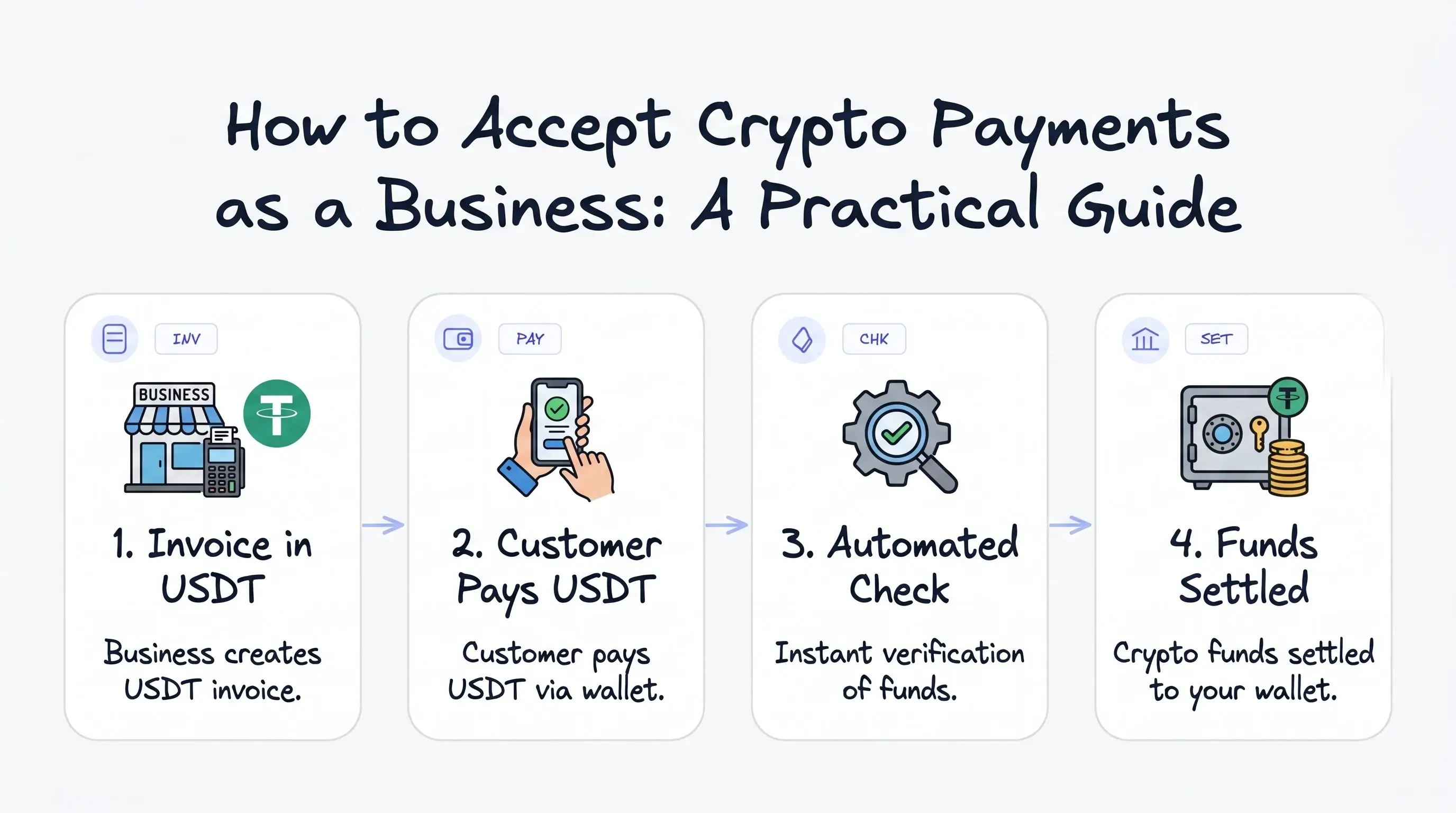
The typical flow for a B2B stablecoin payment involves four steps. First, the sending business converts fiat currency into stablecoins (such as USDC or USDT) via a payment provider, usually on‑platform so that they do not interact directly with the blockchain. Second, the provider broadcasts the transaction to the relevant blockchain network, moving the stablecoin from sender to recipient address without involving correspondent banks or cut‑off times. Third, settlement completes in seconds to minutes depending on network congestion, but still far faster than many cross‑border bank transfers. Fourth, the recipient either holds stablecoins in a wallet or has them converted to local fiat and credited to their bank account, depending on their preference and configuration. For a SaaS vendor, this entire process can be abstracted behind a familiar invoice interface that denominates amounts in fiat while allowing the customer to pay with crypto assets, which is precisely the kind of functionality that mid‑sized crypto gateways like Cryptonly‑type providers aim to deliver.
From an economic perspective, crypto acquiring can lower payment costs, especially for cross‑border transactions. Articles focused on crypto payments for SaaS and digital products in 2026 report that gateway fees can be materially lower than card processors, and that stablecoin infrastructure has matured enough that volatility is no longer a major operational risk when the flow is designed correctly. Merchants can leverage hosted checkout, invoice issuing, and automated payouts while paying fees sometimes in the region of 0.3%, which compares favorably to typical card fees between 2–3% plus FX surcharges. Moreover, the ability to accept more than ten crypto assets, convert between EUR or stablecoins instantly, and operate under regulatory frameworks such as MiCA in Europe increases trust and adoption.
To visualize the trade‑offs between different payment options for a new SaaS, it is useful to compare them across dimensions that matter during launch: settlement speed, global reach, fee level, and implementation complexity.
| Payment method | Typical settlement speed | Global reach and FX handling | Approximate fee level | Implementation and maintenance complexity |
|---|---|---|---|---|
| Card processors (Visa, MasterCard via Stripe, etc.) | Seconds for authorization, days for payout | Strong in developed markets; FX spreads and cross‑border fees apply | Around 2–3% per transaction plus FX | SDKs are mature; requires PCI considerations and dispute handling |
| Bank transfers (SWIFT, SEPA) | Hours to days, sometimes longer cross‑border | Varies by corridor; FX and compliance heavily involved | Low direct fees but higher operational cost | Integration via banking partners; reconciliation and compliance overhead |
| Legacy wallets / PayPal‑type services | Immediate wallet transfers, delayed bank withdrawal | Broad consumer coverage; FX and cross‑border fees similar to cards | Often comparable to or higher than cards | SDKs and plugins exist; dispute management and wallet policies add constraints |
| Crypto and stablecoin gateways (e.g., Cryptonly‑type) | Seconds to minutes on blockchain, fast fiat conversion | Global by design; value transferred in stablecoins or major crypto assets | Often around 0.3–1% with minimal FX spreads | API, SDK, hosted checkout, and plugins reduce engineering overhead; requires crypto compliance posture |
This table does not argue that one method is universally superior; rather, it shows why a combination that includes crypto acquiring and stablecoin rails can be uniquely attractive for a new SaaS that wants low fees, fast settlement, and broad international reach without building a large payments team. The actionable takeaway is that even at the “beginner” stage, you should design your payment stack to include at least one flexible rail—such as a Cryptonly‑style gateway—that allows you to accept global payments and store or convert balances with minimal manual work. Doing so makes your business more resilient to regional constraints and unlocks revenue from segments that would otherwise be excluded by card or bank limitations.
From Launch To Expert‑Level Operations: Optimization, Retention, And Data‑Driven Execution
Once your SaaS is live, paid, and growing, the challenge shifts from “can we launch?” to “can we optimize and scale without losing control?” Expert‑level SaaS operation involves continuous improvement across onboarding, retention, pricing, and marketing, guided by data but constrained by the finite bandwidth of your team. The founder mindset changes from building features to building systems—for product experimentation, financial tracking, and customer feedback—that allow the organization to learn and adapt faster than competitors.
Onboarding, Activation, And Product Analytics
User onboarding is the first optimization frontier because it directly affects activation and therefore revenue. Research on SaaS onboarding best practices emphasizes segmenting users when they first arrive, typically via a welcome survey that asks about their role, goals, and context. This segmentation allows you to design flows tailored to each segment, with each flow centered around a single activation milestone, such as creating the first project, connecting the first data source, or issuing the first invoice. Rather than bombarding new users with every feature, you focus on guiding them to the milestone that correlates most strongly with long‑term retention and monetization.
To operationalize this, you need basic product analytics that can measure activation rates and cohort behavior. Lean startup methodology suggests that meaningful metrics should be tied to learning objectives, not vanity metrics such as raw sign‑up counts. If your hypothesis is that “users who accept a payment via stablecoin within their first week are more likely to become paying customers,” you must instrument that event and track its frequency and downstream revenue. Tools ranging from lightweight analytics libraries to full‑featured product analytics platforms can help you monitor these flows, but the crucial piece is the mindset: you adjust product and onboarding based on data, not intuition alone. Over time, this leads to incremental changes—such as simplifying a field, reordering steps, or clarifying copy—that cumulatively increase activation and conversion.
SEO, AI Overviews, And Discoverability For A 2026 SaaS
In 2026, SEO is no longer just about ranking in classical blue‑link results; it is also about being selected by AI‑driven summary systems such as Google’s AI Overviews. Google’s guidance on optimizing websites for generative AI features emphasizes that content should be well‑structured, technically sound, and clearly answer user questions. AI Overviews are shown primarily for informational queries, synthesizing content from multiple sources to provide an instant high‑level answer. For a SaaS vendor, this means that your documentation, blog posts, and landing pages must be written so that AI systems can easily identify you as a credible source on specific topics—for example, “crypto payments for SaaS,” “stablecoin billing for B2B,” or “micro‑SaaS launch frameworks.”
Technically, this requires clean HTML structure, descriptive headings, and relevant schema markup where appropriate, along with fast performance and mobile friendliness. From a content perspective, you should adopt a Q&A style where each page directly addresses a well‑defined question, offers a concise summary near the top, and then develops detailed, evidence‑backed sections that match the query intent. Using up‑to‑date data and clear citations reinforces trust, not only for human readers but also for AI systems that seek authoritative sources. For instance, explicitly stating SaaS market sizes, failure rates, and crypto adoption statistics with references makes your content a strong candidate for factual snippets in AI Overviews.
For founders moving from beginner to expert, the takeaway is that content strategy is part of GTM, not an afterthought. You design articles and guides that align with your ICP’s search behavior and your product’s differentiation, and you write them with enough precision that both search engines and AI systems can use them in synthesized answers. Over time, this creates an inbound flywheel where prospects discover your expertise on topics such as “global pricing strategy for SaaS,” “how to accept crypto payments,” or “designing B2B onboarding flows,” and then encounter your product as a natural solution embedded in those narratives.
Risk Management, Team Dynamics, And Execution Discipline
Even with strong product, GTM, and payments, SaaS startups can fail due to organizational issues. Studies of SaaS failure rates highlight factors such as poor financial discipline, weak team cohesion, and inability to stay competitive as common causes beyond product‑market fit. Founders who want to avoid burnout need to design execution discipline into their company from the beginning. This includes realistic runway modeling, where you forecast expenses and expected revenue, ensuring that you have enough buffer to iterate on product and GTM without hitting a sudden cash wall. It also includes clear role definitions, regular check‑ins, and a culture that encourages honest feedback and course correction rather than heroics and denial.
Financial management intersects with payments and pricing decisions. If you adopt complex pricing structures without understanding their impact on cash flow, you may generate bookings that look attractive but collect slowly or unreliably. Similarly, if you ignore alternatives like crypto rails that could reduce fees and settlement times, you may be leaving material efficiency gains on the table. Expert‑level founders review their payment stack and pricing quarterly, adjusting fees, discounts, and accepted methods based on both customer preferences and internal economics. They also consider tax implications and regulatory requirements of crypto usage, leaning on enterprise guides and external advisors when necessary.
On the competitive front, continuous monitoring of market trends helps prevent stagnation. SaaS markets evolve quickly, with new entrants offering AI‑powered capabilities, novel integrations, or better UX. To stay competitive, you must periodically reassess your positioning and differentiation, updating your manifesto and messaging where necessary. This does not mean chasing every trend; it means consciously deciding which innovations—such as integrating a new blockchain, supporting additional stablecoins, or adding AI‑assisted workflows—align with your ICP’s needs and your product’s core value. The discipline to say “no” to misaligned opportunities is as important as the creativity to explore new ones.
Conclusion: A Beginner‑To‑Expert Path For SaaS Founders In 2026
Bringing the threads together, launching a SaaS product in 2026 without burning out requires an integrated strategy across idea validation, product design, GTM, monetization, and payment infrastructure. The thesis is simple: respect the data that shows high failure rates and competitive pressure; respond by designing a lean, focused launch that validates demand, messaging, and monetization quickly; and leverage modern payment rails, including crypto and stablecoins, to reduce friction and expand global reach. The context is a market where SaaS revenue is growing rapidly but where most new entrants still fail, often because they either build too much without validation or neglect practical aspects such as GTM and payments.
Evidence from SaaS market analyses, failure studies, GTM playbooks, and crypto payment guides collectively supports a set of key practices. These include rigorous ICP and value proposition work before heavy development; MVPs anchored on clear activation milestones; staged GTM from organic to paid to outbound; multi‑currency pricing with appropriate billing infrastructure; and adoption of low‑cost, fast‑settlement payment rails via gateways that abstract blockchain complexity. Cryptonly‑type providers exemplify how a mid‑sized crypto payments platform can help SaaS vendors accept crypto and stablecoins, track wallet settlements, and manage balances via dashboards, APIs, SDKs, or plugins, thereby simplifying global monetization for teams that cannot yet build bespoke payment infrastructure.
The actionable takeaway for a beginner founder aiming to reach expert‑level execution is to treat payments and billing as strategic design choices, not mere plumbing. By integrating a flexible crypto acquiring solution alongside traditional methods, you create a resilient monetization engine capable of serving customers worldwide from day one. By layering that engine on top of a lean product, disciplined GTM, and data‑driven optimization, you dramatically improve your odds of becoming part of the minority of SaaS startups that survive beyond five or ten years. In that sense, launching a SaaS in 2026 without burning out is less about working harder and more about architecting your product, business model, and payments stack so that each element reinforces the others, letting evidence and efficiency—not chaos—guide your growth.
Related articles
- Comparing Crypto Payment Gateways in 2026: How to Choose YoursThere is no "best" crypto gateway — only the one that fits your business. We compared five gateways on fees, KYB friction, and withdrawal terms so you can choose based on your priorities.
 How to Accept Crypto Payments as a Business: A Practical GuideA wallet address can receive crypto. A business needs a payment flow that tells your team who paid, what it belongs to, and when it is safe to fulfill.